
Framingham Administration’s Extreme Misuse of State Chapter 70 Education Aid Caused Schools Budget Crisis
For years the city has pursued building reserves and lowering taxes at the expense of disadvantaged students. That cannot continue.


NOTES
1. This is the first in a series of articles on major problems with city financial management, which has already caused significant damage in the school system, and threatens further damage, with substantial staff cuts. The city’s financial planning weakness has a substantial history, and affects all areas of government, including infrastructure, environment and residential development. The city is at a fork in the road, and decisions made in the FY27 budget cycle will have a major impact on the city’s future.
2. In prior critical commentary the focus was largely on the $18 million which the city cut from local education funding in the last 4 years. In this article, the scope is expanded to include all of the annual schools budget increases, which were funded entirely with state Chapter 70 Student Opportunity Act money. That deprived disadvantaged students of a further $60 million in support.
In the past, this newsletter has carried a number of stories about Framingham’s diversion of state Chapter 70 Student Opportunity Act (SOA) funding away from its intended target of disadvantaged students, to strengthen the city’s financial position:
Framingham Councilor George King Impedes Schools Educational Progress (4/9/25)
Mayor Sisitsky Continues Financial Attack on Framingham Public Schools (4/2/25)
Third Year of Zero Tax Dollars for Framingham Schools Budget Increases (4/16/24)
George King’s Rules Will Break the Framingham Public Schools (6/27/23)
Framingham City Council Financial Strategy Threatens Our Future (6/5/23)
Framingham Cuts Education by $10 Million/Year to Fix Cityside Problems (4/2/23)
The city’s mismanagement of Chapter 70 Student Opportunity Act funding has now led to a real crisis in the FY27 Framingham Public Schools (FPS) budget, where continuation of the disastrous city approach to school system funding is projected to cause the loss of almost 100 staff members, most of whom serve the population of disadvantaged students: low income students, English learner students, and students with disabilities.
Although this topic was not mentioned in the recent Mayor’s state of the city address, it remains the biggest threat to Framingham’s substantial low income, immigrant community, in company with ICE operations which affect the same demographic most severely.
Who are we as a community when we join together to condemn the federal exercise of militarized enforcement power against a defenseless population, which is simply trying to survive, but do nothing as our local government uses its financial power to ensure that state education support, in ample measure, is stripped away from this very same population?
In a further troubling development, it is also becoming quite clear that support for students with disabilities has also been eroding in concert with the erosion of support for low income and English learner students.
The final really important point is that the educational neglect of a very large segment of the student population makes the quality of education worse for all students, as teachers struggle to manage classrooms which grow more challenging each year.
For this reason, an updated review of the situation is essential and is engaged in here.
Key outcomes from this review are as follows:
1. Most of the boosted state Chapter 70 Student Opportunity Act funding entirely failed to improve anything for its target students over the last 4 years. Just $25 million out of $104 million in boosted Chapter 70 funds was spent on actual improvements for students.
2. The remaining almost $80 million was used to fund annual inflation adjustments for existing staff salaries, cover inflation increases in expenses, and send $18 million back to the city to improve its financial reserves.
3. The diversion of the impact of SOA funds from student improvement had major negative impacts:
a. Student performance declined for 4 years across most grades. See the state data at: https://profiles.doe.mass.edu/mcas/mcascharts2.aspx?linkid=33&orgcode=01000000&fycode=2025&orgtypecode=5&
b. Pre-K expansion to all 4-year-olds stalled, so hundreds of children now arrive in kindergarten each year, not speaking English.
c. Classroom support for teachers weakened due to a shortage of aides, caused by aide pay lagging market rates by about 20%.
d. Experienced teachers began leaving FPS in large numbers. At least 100 left for jobs in other school districts in each of the last 2-3 years.
4. All of these negative impacts were amplified by chronic late buses due to a shortage of school bus drivers caused by low pay. The city had ample funds to boost driver pay to the going rate of $34/hour from $29/hour, but failed to achieve that year after year. The School Committee intervened, brought busing inhouse, raised driver pay and solved the problem.
Review Details
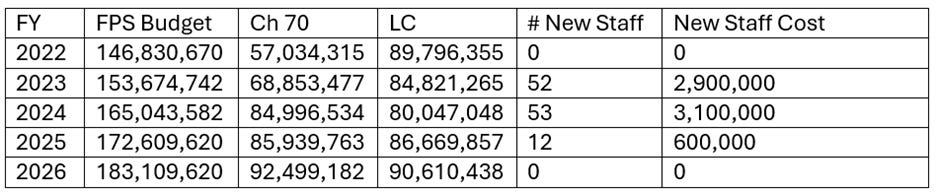
First, it is necessary to look at the Framingham Public Schools (FPS) financial data from the past 4 years, as shown in the following table:
FY = Fiscal Year
LC = Local Contribution to the FPS budget, funded by city tax revenue
Ch 70 = State Chapter 70 education funding
FPS Budget = Ch 70 + LC
The Local Contribution chart, presented in earlier articles, is provided here again for reference:
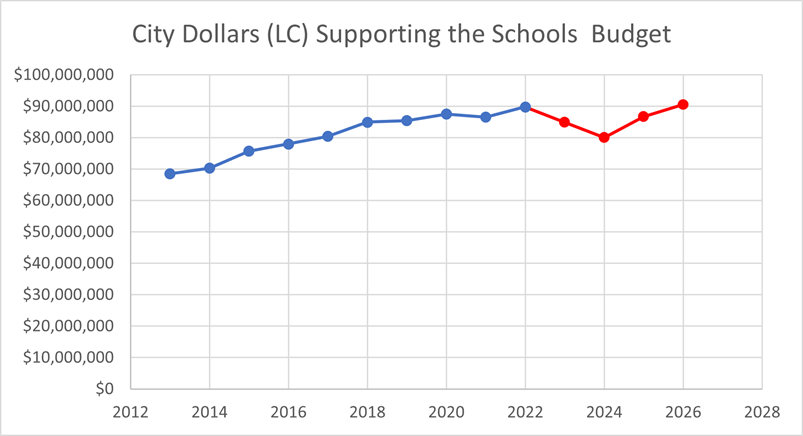
The cuts in the last 4 years are obvious and show the reduced city support for the schools.
In 2022, about $90 million of the city tax levy was dedicated to the school system. In subsequent years that dropped substantially so that a total of $18 million was removed from school system support and ended up in city coffers, boosting the city’s financial position on the backs of disadvantaged students.
For further contrast, the next chart shows the information in the first chart plotted along with the cityside portion of the tax levy.
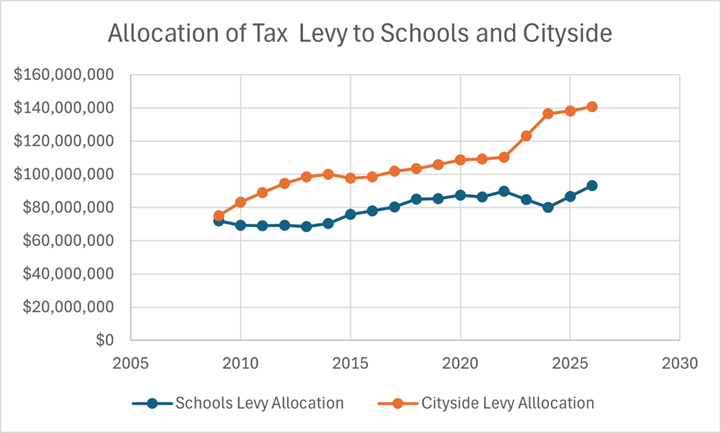
The contrast is striking. As the support for the schools was cut, the cityside funding rose rapidly. Nowhere is it more obvious that the city administration was totally focused on boosting cityside finances at the expense of the schools.
In that same 4 year period, not only did the school system become a revenue source of $18 million for the city, but not a single dollar of city revenue went to any of the FPS budget increases. All of those budget increases were paid from Chapter 70 state education aid, which increased substantially in that period due to boosted funding from the Student Opportunity Act.
A lot has been said about the $18 million going to the city, but the fact that the city paid ALL of the FPS budget increases for 4 years from Chapter 70 funding is even more devastating.
From the table above, the accumulated increase in Chapter 70 funding over the 4 years totaled about $104 million. Here is how that was spent:
$18 million filled in the gap left by the lowered local contribution.
$25 million went to about 116 new staff, hired to meet the intent of the Student Opportunity Act.
The remaining $61 million paid for compensation increases for existing staff and inflation increases in expenses. None of this was aimed at boosting student achievement.
So, just $25 million out of $104 million of boosted Chapter 70 funding from the Student Opportunity Act reached its target of low income students, students with disabilities, and English learner students.
This is how the city blunted the impact of the Student Opportunity Act and deprived disadvantaged students of about $80 million in funding which could have:
Solved the late bus problem by boosting driver pay.
Provided free pre-K for all 4-year-olds
Boosted classroom aide pay by 20%, to solve the shortage of quality staff
Prevented student achievement declining over the last 4 years.
Prevented the departure of hundreds of experience teachers in the last 2-3 years.
The FY27 FPS Budget Cut Insanity
With this ground truth established, the current crisis with the FY27 FPS budget can be understood in very simple terms.
Having hijacked about ¾ of the state funding meant for improving disadvantaged student performance, the city is now proposing a cut of $8 million in the FY 27 FPS budget, which would remove almost all of the 117 new staff added over the last 4 years to serve disadvantaged students.
If this becomes reality, the remaining Student Opportunity Act support for disadvantaged students will vanish completely.
Never has it been more obvious that there should be no such cut. At the very least, the $18 million in cash the city took should be tapped to fill the FY27 budget gap.
That would keep minimal support in place and prevent more damage to the schools.
Then the city should spend the next year figuring out a solution to its financial and educational problems.
The next article in this series will show how Framingham is one of the top two worst districts in the state in diverting Student Opportunity Act from its intended goal of boosting the performance of disadvantaged students. Further articles will suggest possible ways to wean the city off its prolific misuse of Chapter 70 state education aid, and provide more analysis of the city’s poor history of financial mismanagement.
One closing thought is that Framingham government should reflect on the fact that it seems to be blind to the reality of its demographics.
Here is the demographic transition occurring in the schools:
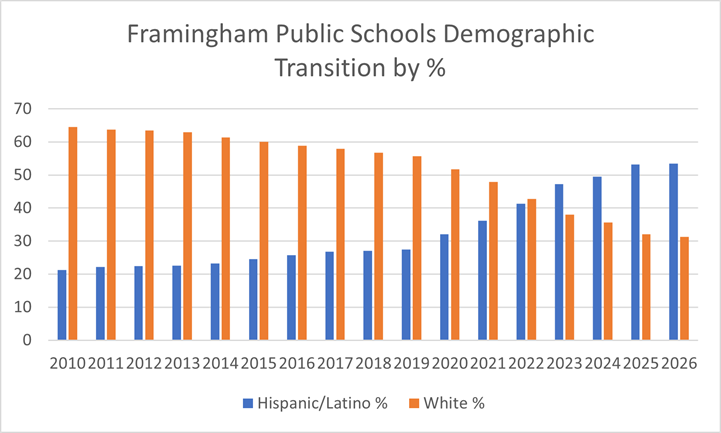
The optics of city decision making regarding the schools is very troubling when it is quite clear that the demographics of the Mayor and City Council obviously have nothing in common with the student demographics in the school system.